Article
Mar 31, 2026
Atlassian & AI: The Complete Story
An inside look at Atlassian’s transformation into an AI-first platform, and how agentic workflows, governed data, and Forge are redefining enterprise collaboration.
From Smart Predictions to Agentic Teammates, And What It Means For Your Business
March 2026 • By the ONETEEM Team • ~20 min read
Something extraordinary has happened to Atlassian in the past three years. The company that most teams know as "the Jira people" has quietly transformed into one of the most ambitious AI-native platform companies in enterprise software. And as a team that builds on the Atlassian Forge platform every day, we at ONETEEM have had a front-row seat to every stage of this transformation.
This isn't a press release recap. This is the full story told by practitioners who live inside this ecosystem of how Atlassian went from machine learning experiments you probably never noticed, to an AI platform where artificial agents now sit on your Jira board alongside your human teammates.
If you use Atlassian products, plan to use them, or build on them, this article is for you. Grab a coffee.

IN THIS ARTICLE
01- The Quiet Foundations (2019–2022)
02- Atlassian Intelligence Arrives (2023–2024)
03- Rovo Changes the Equation (2024)
04- The Agentic Shift (2025–2026)
05- Under the Hood (How It All Works)
06- Forge (The AI-Native Development Platform)
07- How Atlassian Stacks Up
08- What Comes Next (2026–2028)
CHAPTER 1
The Quiet Foundations (2019–2022)
Atlassian’s AI story didn’t begin with ChatGPT. Years before generative AI captured headlines, the company was making strategic moves that would become the scaffolding for everything that followed. Most people missed it.
Acquisitions That Planted the Seeds
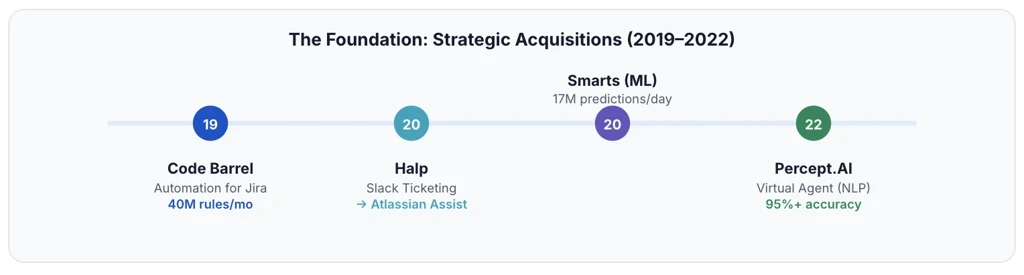
October 2019: Code Barrel acquired maker of Automation for Jira. Already serving 6,000+ customers executing 40 million automation rules per month. Today it powers millions of workflows, the foundation AI agents build on.
May 2020: Halp acquired, a Slack-first ticketing startup with automated knowledge-base responses. Later rebranded to Atlassian Assist and integrated into JSM, planting the seed for conversational AI.
January 2022: Percept.AI acquired, a Y Combinator-backed virtual agent with 95%+ NLP accuracy. This became the backbone of JSM’s virtual agent one of the most impactful AI features shipped to date.
CHAPTER 2: Atlassian Intelligence Arrives (2023–2024)
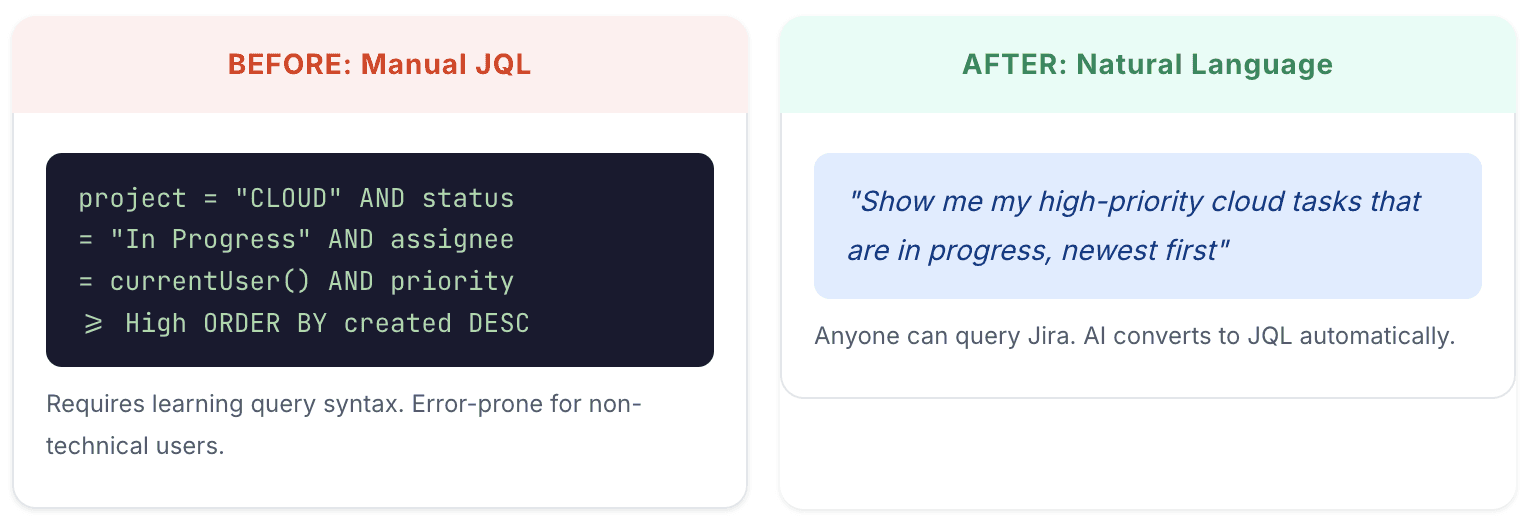
On April 19, 2023, at the Team ’23 conference, Atlassian announced Atlassian Intelligence, an AI layer combining the company’s own ML models with OpenAI’s GPT-4. For the first time, generative AI appeared inside Jira, Confluence, Bitbucket, and JSM.
What It Could Do
Natural language to JQL: Anyone could query Jira without learning query syntax.
AI definitions: Automatically explained company-specific jargon in Confluence.
Generative editor: Draft, rewrite, and adjust tone across products.
Virtual agent: In JSM, built on Percept.AI tech, handling requests autonomously in Slack and Teams.
Trust by Design
Critically, Atlassian’s agreement with OpenAI included opting out all user data from being used to train GPT models. Computing happened on Microsoft Azure, and Atlassian supplemented GPT-4 with open-source models from the Llama and Phi families alongside self-hosted models, a multi-model approach that would later evolve into the AI Gateway.
General Availability: December 2023
By the time GA arrived on December 11–12, 2023 at the Unleash event in Amsterdam, Atlassian had made a pivotal decision: Atlassian Intelligence would be included in Premium and Enterprise plans at no extra cost.

CHAPTER 3: Rovo Changes the Equation (2024)
If Atlassian Intelligence was the AI layer inside existing products, Rovo was the AI layer that transcended them. Announced at Team ’24 in Las Vegas on May 1, 2024, Rovo represented Atlassian’s most ambitious AI product built on three pillars:
Pillar | What It Does |
Find (Rovo Search) | Enterprise-wide discovery across Atlassian tools and 50+ third-party SaaS connectors including Google Drive, SharePoint, GitHub, Slack, and Figma. |
Learn (Rovo Chat & Knowledge Cards) | Conversational AI grounded in company data surfaces information, explains context, suggests follow-ups. |
Act (Rovo Agents) | Specialized AI virtual teammates. 20+ pre-built agents at launch, plus custom agents built with natural language. No programming required. |

By April 2025, Atlassian made a pivotal pricing move: Rovo was bundled into Premium and Enterprise subscriptions at no extra cost, eliminating the separate SKU and dramatically expanding the user base.
ONETEEM PERSPECTIVE
“We were among the first Atlassian partners to architect Forge apps that integrate deeply with Rovo AI agents, using Forge Realtime for live AI suggestions and Rovo actions for intelligent task automation.”
CHAPTER 4: The Agentic Shift (2025–2026)
This is where the story accelerates. The shift from AI as an assistant to AI as an autonomous participant in work.
5 Million Users and Counting
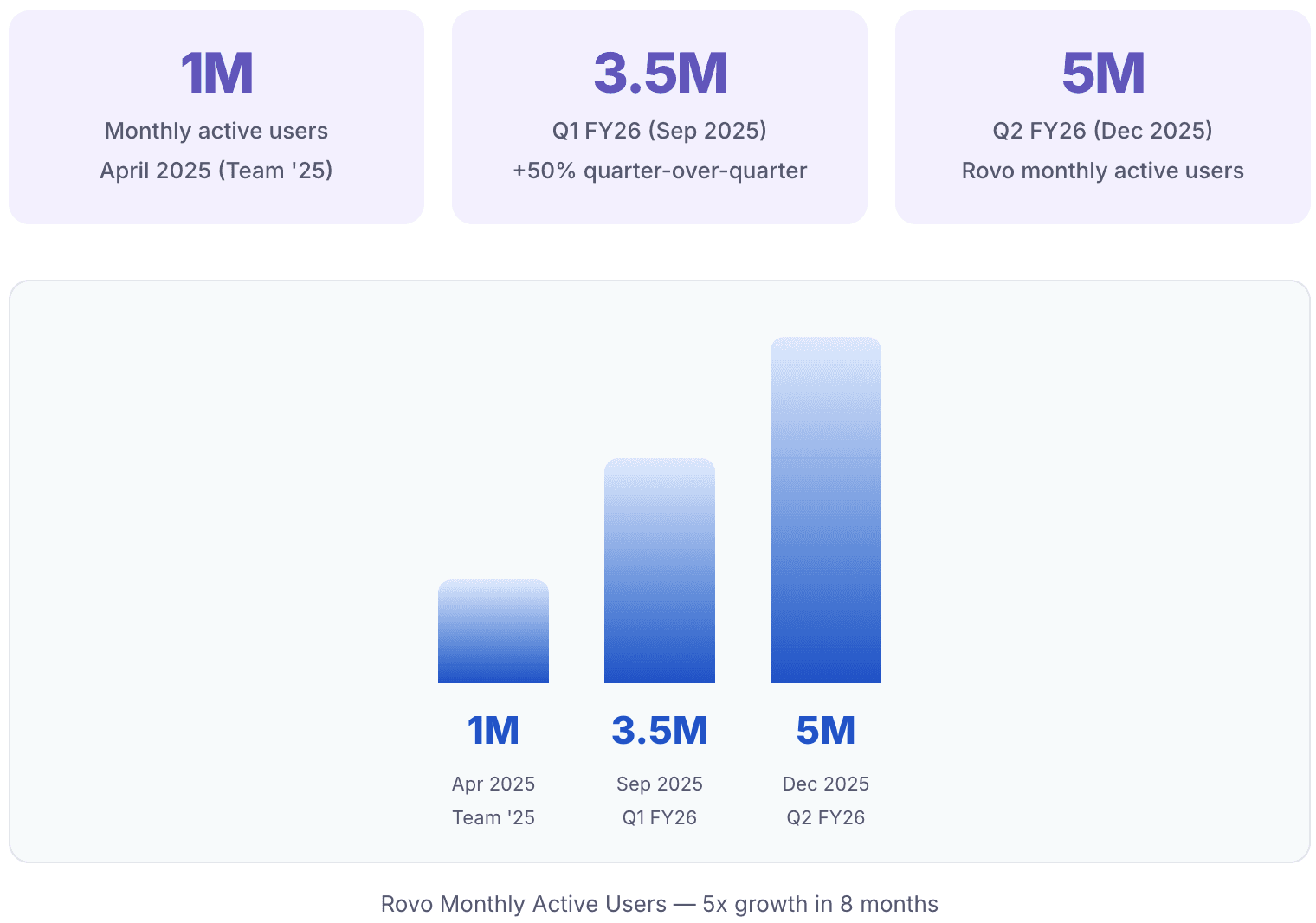
CEO Mike Cannon-Brookes delivered the milestone in the shareholder letter: Atlassian crossed 350,000 customers, Rovo Chat usage had grown 50x in six months, and Rovo agents had powered 2.4 million workflow automations.
Agents in Jira: The February 2026 Watershed
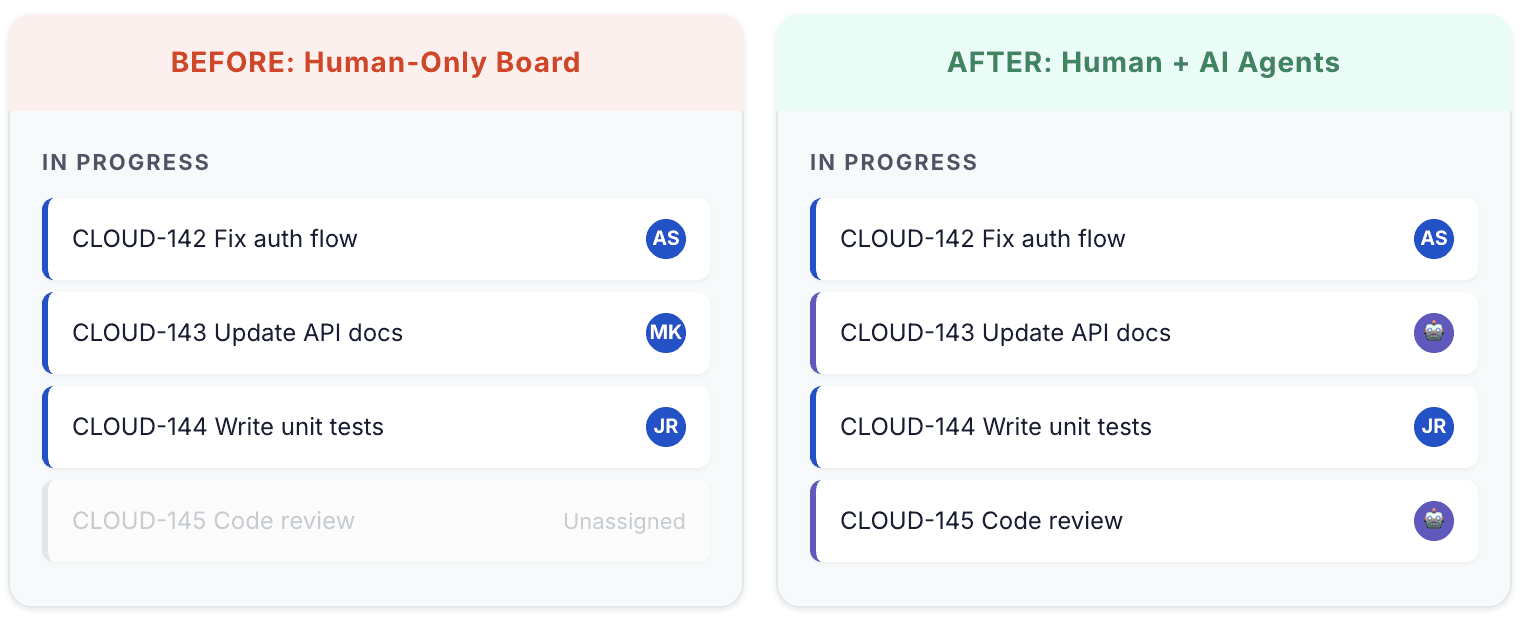
The most significant product announcement of 2026 arrived on February 25, when Atlassian launched the open beta of “Agents in Jira.”, it fundamentally changed what a Jira assignee could be.
AI agents appear as assignees in the standard Jira interface, alongside human team members.
Boards clearly show which tasks agents are working on.
Users can @mention agents in comments for iterative, in-context collaboration.
Agents can be embedded directly into Jira workflows, executing automatically at specific status transitions with human review gates.
“You’ve been hearing in the zeitgeist that agents are creating more chaos. What we’re really good at is putting order to that chaos.”
Tamar Yehoshua, CPO, Atlassian
The March 2026 Restructuring
Two weeks later came the most sobering announcement. Atlassian cut approximately 1,600 employees, roughly 10% of its workforce to self-fund further investment in AI and enterprise sales.
Cannon-Brookes was direct: “Our approach is not ‘AI replaces people’ But it would be disingenuous to pretend AI doesn’t change the mix of skills we need.”
Despite strong revenue growth ($1.586 billion in Q2 FY26, up 23% year-over-year), the move was simultaneously a cost discipline signal and a strategic reallocation toward AI.
CHAPTER 5: How It All Works
Understanding Atlassian’s AI isn’t just about knowing the features. It’s about understanding the architecture because that’s where the real strategic advantage lives.
The AI Gateway: 20+ Models, One Interface
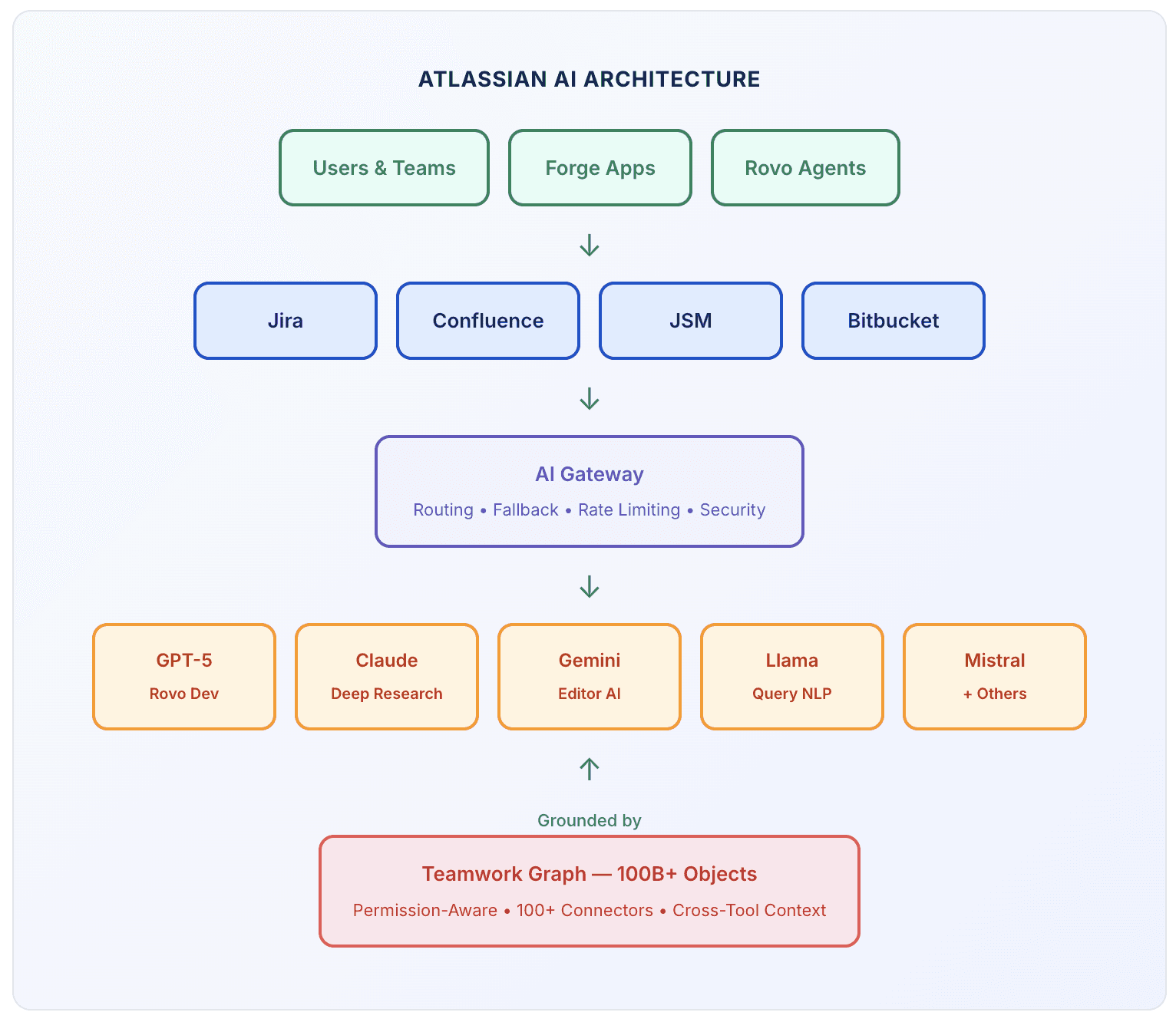
Behind every AI feature sits the AI Gateway, a unified middleware layer routing all AI requests to the right models.

Confirmed providers include OpenAI (GPT-5), Anthropic (Claude powers Rovo’s Deep Research), Google (Gemini for Editor AI), Meta (Llama for query understanding), and Mistral. An automated fallback mechanism detects provider incidents in real time and reroutes requests accordingly, a resilience capability that has already mitigated multiple production outages.
The Teamwork Graph: 100+ Billion Objects
The Teamwork Graph is Atlassian’s proprietary data model, now containing over 100 billion objects and connections. It maps relationships between people, teams, projects, issues, documents, and tools into a unified, permission-aware structure.
While any company can plug into OpenAI’s API, the Teamwork Graph gives Atlassian’s AI answers that are contextually grounded in your organization’s actual work. It’s also permission-aware, running last-mile access checks so AI agents only see what they’re entitled to.
Zero Data Retention with LLM Providers
All third-party LLMs operate under zero data retention. Inputs and outputs are not stored by providers after inference. Organizations can also opt for AI features to exclusively use Atlassian-hosted models for the strictest data requirements.
CHAPTER 6: Forge (The AI-Native Development Platform)
If Rovo is the AI product layer, Forge is the AI development substrate. And it’s rapidly becoming the only way to build on Atlassian.
The Connect Sunset Clock Is Ticking
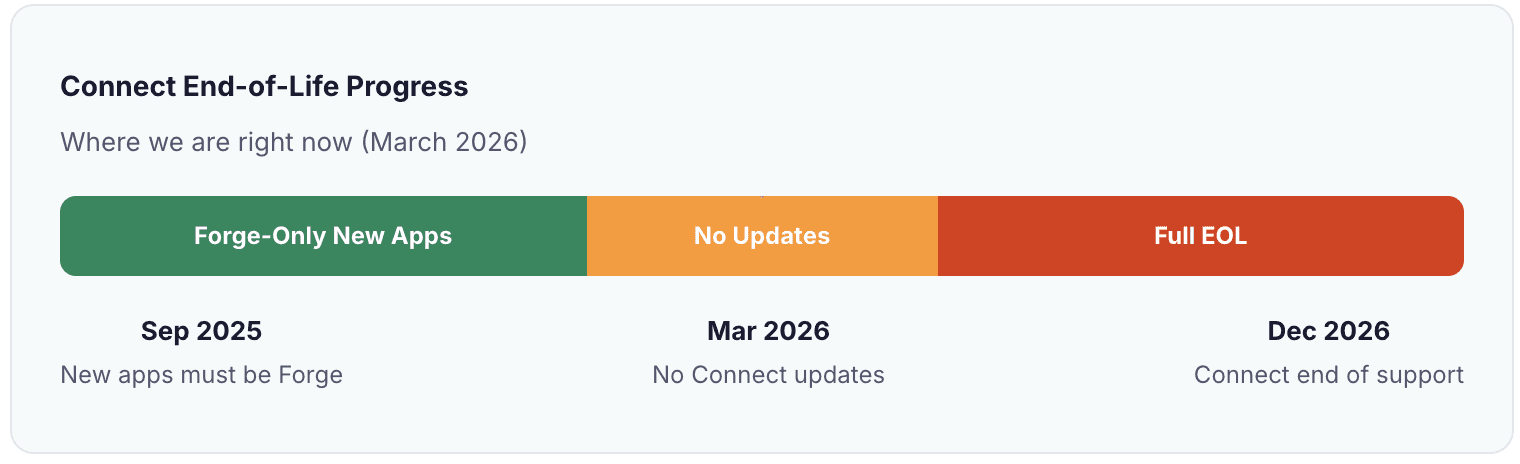
September 17, 2025: All new Marketplace apps must be Forge-only.
March 31, 2026: Existing Connect apps can no longer receive updates.
December 2026: Connect reaches full end of support.
The Forge MCP Server Goes GA
In March 2026, the Forge MCP Server reached general availability. It exposes authoritative Forge and Atlassian Cloud documentation to AI coding agents and IDEs like Cursor, VS Code, and Rovo.
Developers can now prompt their coding assistant “Create a Confluence macro that shows a pie chart of Jira issues by status” and the agent queries the MCP server for real documentation before generating working Forge code.
Financial Incentives Are Aligned
From January 1, 2026, qualifying Forge apps earning the “Runs on Atlassian” badge pay 0% revenue share up to $1 million in lifetime Forge revenue. Standard Forge rates sit at 16–17%, while Connect rates are increasing to 20–25%.
CHAPTER 7: How Atlassian Stacks Up
Every major work management platform is racing from AI assistants toward autonomous agents. But the approaches differ meaningfully.
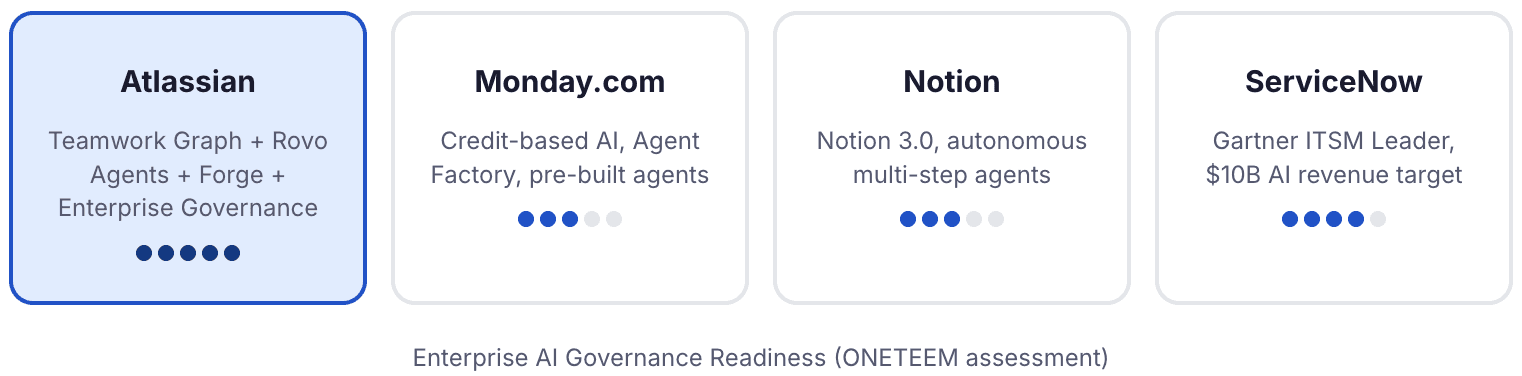
Platform | AI Approach | Key Differentiator |
Atlassian | Teamwork Graph + Rovo Agents + Forge | Governed AI with enterprise permissions & audit trails |
Monday.com | Credit-based AI, "Agent Factory" | Pre-built agents (Portfolio Manager, Service Agent) |
Notion | Notion 3.0, autonomous multi-step agents | Bold consumer-first approach |
ServiceNow | Gartner Leader in ITSM AI | Direct ITSM threat, targeting $10B AI revenue |
The core bet is that enterprise-grade governance, including permissions, audit trails, and approval workflows, will ultimately matter more to enterprise buyers than raw AI capability alone.
CHAPTER 8: What Comes Next (2026–2028)
Atlassian’s trajectory is shaped by several converging forces: the agentic AI acceleration, the forced cloud migration, the Forge platform play, and the expansion beyond developer teams.

Near-term roadmap items include:
Agentic build/test/deploy workflows.
AI-powered alert noise reduction in JSM.
Rovo integration in Jira Align.
Loom AI meeting recaps in 50+ languages.
The Rovo MCP Gallery lets you add new skills to your AI by connecting it to apps like GitHub, Figma, and Canva.
The Cloud Migration Wave
Atlassian's self-hosted product (Data Center) reaches end-of-life by March 2029, moving every remaining on-premise customer to cloud where all AI features live.
FINAL THOUGHTS
Why This Matters And Why ONETEEM
Atlassian's AI journey only makes sense when you see the complete arc. Early acquisitions built the foundations. Atlassian Intelligence brought generative AI to every product. Rovo turned AI into a product of its own. And Agents in Jira completed the shift, transforming AI from a helpful assistant into a governed, accountable teammate. As AI agents multiply, the real challenge is no longer capability, it is control. Who did what, when, and who approved it. Atlassian is betting that its governance infrastructure, Teamwork Graph, and Forge platform make it the natural home for teams trying to manage humans and agents working side by side. We have not watched this evolution from the sidelines. Every stage described in this article is something we have lived through as practitioners shipping production code on the Atlassian platform every day.For organizations building on the Atlassian platform, the message is unambiguous. AI is not a feature being added to Atlassian products, it is becoming a significant part of the products.